Artikeln i korthet
- Motståndet mot generativ AI: Det är inte bara den nya generationens arbetskraft som slår bakut mot ”AI först”-trenden, det finns en växande rörelse som vill skydda den mänskliga kreativiteten och värna våra kritiska tänkande.
- Dolda risker på arbetsplatsen: Studier visar att en ökad användning av AI-verktyg också leder till internt missnöjde. ”Workslop”, alltså ”onödigt” AI-genererat material, försämrar medarbetarnas kognitiva förmåga och skadar förtroendet för ledarskapet i stort. Genom att använda stora språkmodeller till allt, skapar vi på en ”produktionsdöd” – vi slutar helt enkelt att tänka själva. Då blir innehållet också därefter.
- Hot mot kundlojalitet och varumärke: Automatiserad text och annan AI-genererad kommunikation skapar en skepsis kring varumärkets äkthet, vilket försämrar relationen till kunderna. Vi har länge pratat om autenticitet, och kan konstatera att det är fortsatt centralt i vår marknadsföring och kommunikation.
- Framtidens ledarskap är ”Human-more”: En på lång sikt, framgångsrik digital transformation, handlar inte om att göra organisationen mindre mänsklig (humanless), utan om att använda AI för att förstärka den mänskliga förmågan. Lättare sagt än gjort, men värt att resonera kring och arbeta för.
Graduating students across several American univerisities recently booed commencement speakers who brought up AI as a driving force for the future of business and society. At Harvard’s Class Day, however, comedian Ronny Chieng was cheered for his direct, humorous, and intelligent criticism of the use of AI for tasks requiring creativity and critical thinking.
He explicitly stated ”I’m here to tell you the mission of your generation is to destroy AI, kill it”. The relentless and all-encompassing push for AI first and everywhere is being pushed back by the next generation workforce.
Not all AI is equal. Prediction models have quietly run electrical grids, fraud detection systems, and weather forecasts for decades without controversy. The backlash is aimed squarely at generative AI systems that replace human creativity, enable mass surveillance, exploit addictive interaction patterns, and increasingly make autonomous decisions about who lives and who dies.
In the workplace, resistance to change is a typical feature of any technology adoption initiative.
However, what we now see with respect to AI are more specific push-backs:
- AI-generated content with limited substance, so-called workslop, reduces credibility. A Stanford/BetterUp study found that this lead to internal mistrust and more time wasted busywork (link: https://www.hr-brew.com/stories/2026/02/10/workslop-ai-workplace-communication)
- Trust erodes when leaders communicate with AI-generated messages. A study at University of Florida found that this practice causes a ”perception gap” where employees question the leader’s sincerity, integrity, and leadership ability. (link: https://www.sciencedaily.com/releases/2025/08/250811104226.htm)
- Hallucinations in text and source references cause professional discreditation, e.g. journalism (link: https://pressgazette.co.uk/publishers/digital-journalism/ai-journalism-mistakes/) and law (link: https://www.advokatbladet.no/hoyesterett-kunstig-intelligens/hoyesterett-har-mottatt-sitt-forste-prosesskriv-med-oppdiktede-kilder/227171)
- AI-authored brand communications trigger authenticity scepticism and reduce customer loyalty, particularly where emotional connection is the goal. (link: https://www.sciencedirect.com/science/article/abs/pii/S0148296324004880)
- Individuals experience cognitive decline as a consequence of offloading, and stop using AI. An MIT Media Lab study found that over four months, LLM users showed weaker brain connectivity, lower memory recall, and struggled to recall their own work. (link: https://arxiv.org/abs/2506.08872)
Looking back at the digital technology development of the last 20 years, from big data through digital transformation to the current stage where both data, mathematical methods, and processing capacity are readily avilable, AI becomes the natural next step of digital transformation. However, not all innovation equals great progress. As leaders it is up to us to create the future that our children would like to live in. And they are already telling us that we’re on the wrong path. The future of artificial intelligence has to be human-more, not humanless.
The question for your boardroom is therefore not whether to use AI, but whether you are using it in a way your organisation, and your children, can stand behind. If you want help thinking that through, you know where to find me.

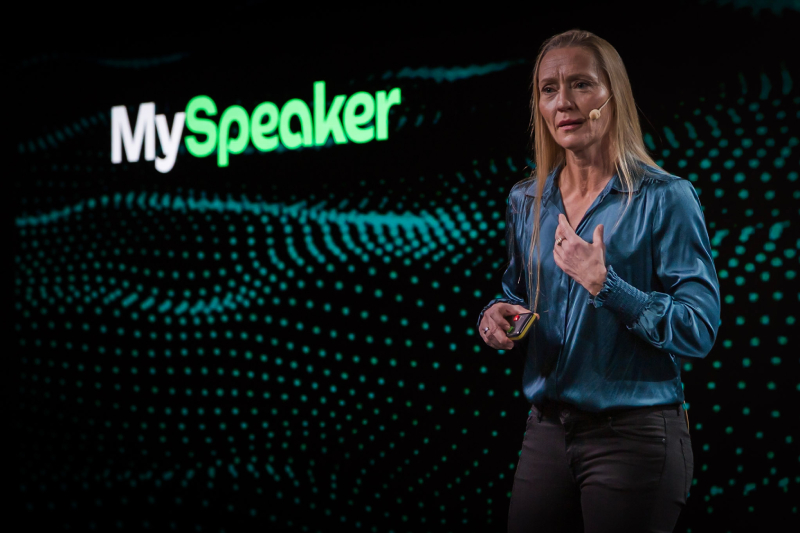
Föreläsare Elin Hauge
Föreläsaren och moderatorn Elin Hauge är affärs- och datastrateg, pragmatisk futurist och en evig rebell. Med sin erfarenhet från fysik och matematik, såväl som affärsliv och juridik, erbjuder Elin nya, tankeväckande insikter kring utvecklingen och användandet av AI och annan datadriven teknologi.